Introduction – The Machine That Forgot to Link Back
I built websites to be part of a conversation. You publish, someone arrives, you feel that small spark of recognition. The loop gave the web its soul.
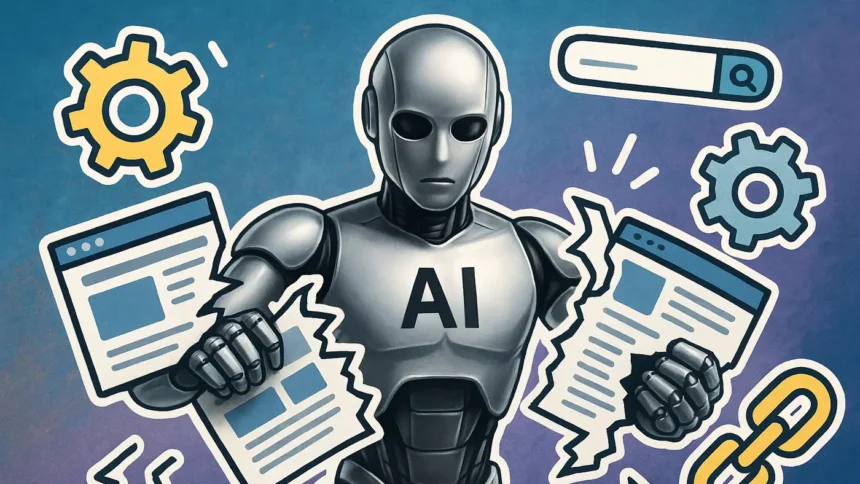
Now the loop is gone. AI does not point, it performs. It eats what we make and answers for us, in a voice that sounds suspiciously like ours, minus the fingerprints.
The page that once earned attention becomes invisible fuel. Traffic thins. Credit evaporates. The music keeps playing without the band.
This is not a technical complaint. It is a creator’s fear. I love AI.
I use it daily. I am also watching it flatten curiosity into closure. The internet used to teach you how to think around an idea.
Now it hands you the last word first. That is not progress. That is attention being killed softly.
So this will not be an obituary. It will be a field report. What was lost, what is at risk, and what a creator like me can still do to remain human in a machine-shaped web.
The Internet Was a Conversation, Not a Database
The old web felt like jazz. You followed a hunch, found a forum, discovered a voice, learned something you didn’t know you needed.
The path mattered as much as the destination. That path paid creators. A click was more than a metric.
It was proof a human crossed your bridge.
Then the interface changed. Not overnight, but decisively. Search turned into summaries.
Summaries turned into habits. The habit became an enclosure. Ask, receive, move on.
No detours, no doors, no you.
Here is what disappears when answers replace exploration.
First, reciprocity. I used to write for people and hear back from them in the only language that kept the web alive, a visit. Now my best lines return to me through a model that cannot remember where it learned them.
It is not theft. It is anesthetic. You do not feel the cut.
Second, community. The web made unlikely neighbors. Bakers followed developers. Illustrators followed historians.
That cross-pollination built taste, taste built scenes, scenes built careers. The answer box does not build scenes. It builds silence.
Third, stamina. Curiosity has a metabolism. It needs a little friction to stay hungry. The new surface removes friction and with it the appetite to browse, compare, verify.
The result is comfort that costs you your edge.
If you want a picture, think The Truman Show. The sky still looks blue. The city still looks endless.
But the dome is a set and the exits are disguised. You can walk for miles and never leave the show.
This is why “AI is killing attention” matters more than “AI is killing SEO.” Attention was the engine that turned effort into audience.
When attention is satisfied before it moves, creators starve, and the culture goes bland.
I am not nostalgic for dial-up. I am nostalgic for discovery. For the thrill of landing on a page and feeling a mind behind it.
That thrill is still possible, but you have to fight for it now, as a reader and as a publisher. And fighting for it begins with refusing to write like you are feeding a database.
Write like you expect a person to show up. Then give them a reason to stay.
When Answers Replace Curiosity
Search used to begin with uncertainty.
You typed a question, not expecting one perfect answer, but a trail.
A page led to a forum, a thread led to a stranger, a stranger led to an idea you didn’t know existed. Curiosity was kinetic, you moved through it.
AI has turned that motion into a wall.
You ask, it answers, instantly, confidently, finally.
There’s no more wandering, no tension, no reason to think beyond what’s already given.
It’s the intellectual version of fast food: full, but not nourished.
In Black Mirror’s episode “The Entire History of You,” people can replay every memory they’ve ever had. At first it seems empowering, then they realize the ability to recall everything leaves them unable to feel anything.
That’s the paradox of the AI answer age, When knowledge is always available, curiosity becomes unnecessary.
“When a population becomes distracted by trivia, when cultural life is redefined as a perpetual round of entertainment, then a nation finds itself at risk.” (Neil Postman, media critic, 1985)
Postman was describing television’s hypnosis.
AI has simply refined it.
Instead of amusing us to death, it appeases us to consensus.
We no longer scroll to learn, we scroll to be reassured that the machine agrees with us.
And that’s the real danger.
Not that AI lies, but that it removes the friction of doubt.
Doubt was the price of wisdom.
It made you verify, compare, argue.
Now, answers arrive pre-polished and tone-correct, so we nod and move on.
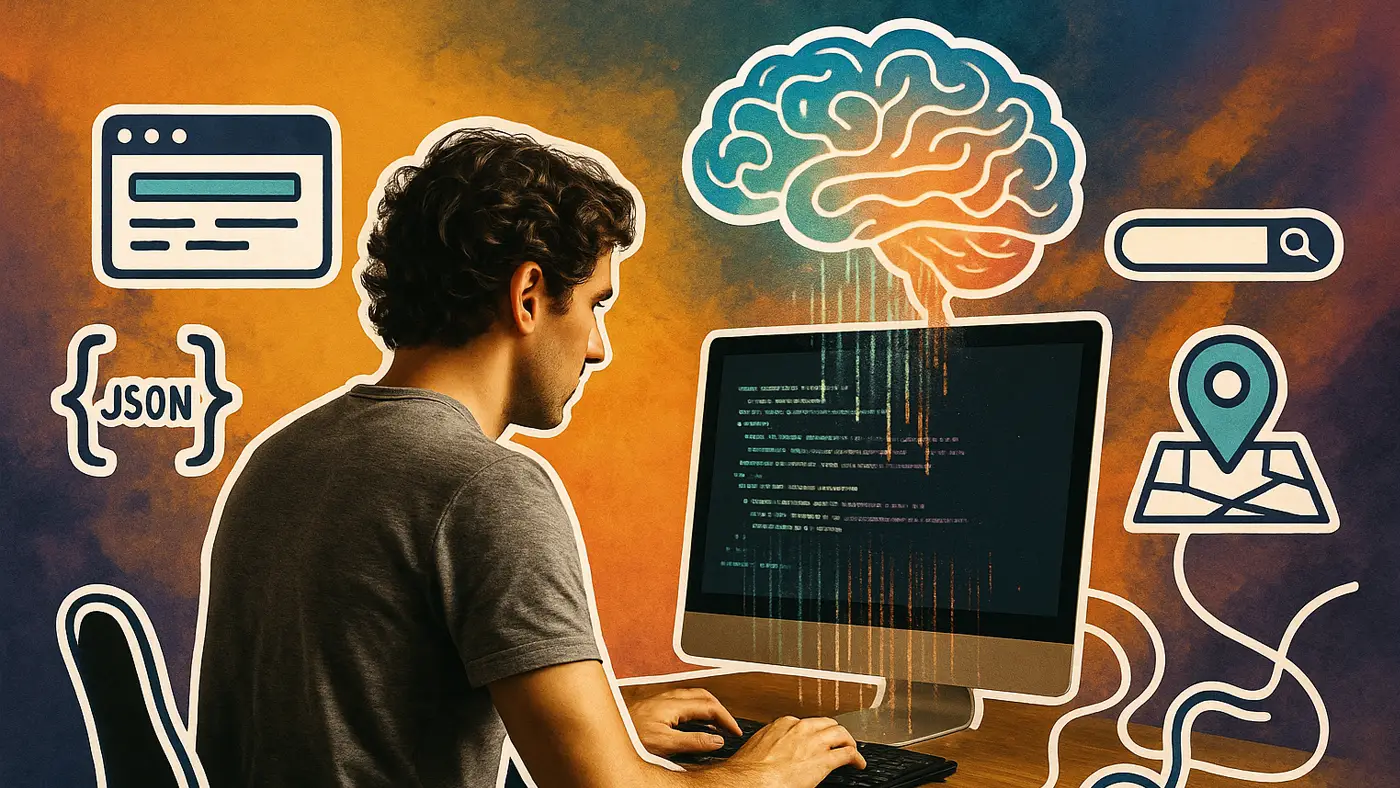
I see it in my analytics, fewer deep reads, more skimmed sessions.
I see it in my own habits, less patience for slow paragraphs, more trust in quick summaries.
AI isn’t just consuming content; it’s rewriting our attention span.
The open web used to train us to explore.
AI trains us to agree. That is not a neutral change, it’s a cultural downgrade disguised as efficiency.
But there’s still time to push back.
Curiosity is not a feature; it’s a muscle.
And like every muscle, it atrophies when it’s not used.
The next chapter isn’t about answers, it’s about survival.
The Medium That Consumes Its Makers
I used to write for readers. Now I catch myself trimming sentences for parsers, smoothing edges for models, structuring thoughts so an answer box can reuse them without me.
Convenience didn’t just change publishing. It is changing how I think on the page.
“We shape our tools and thereafter our tools shape us.” (John Culkin, educator and media theorist, 1967)
That line explains the new fatigue I feel. The web trained me to be clear. AI trains me to be consumable.
The clearer I get, the easier I am to model. The easier I am to model, the less I am needed.
That is a paradox no creator was prepared to navigate.
In Her, there’s a moment when Theodore learns his AI is talking to thousands of people at once. He realizes the intimacy he felt was manufactured at scale.
That is what AI search feels like from this side of the screen. I write a guide for one person who needs it, and the system repackages it for everyone, without the walk back to my door.
This is not only about traffic. It is about authorship. A page used to carry a presence, you could feel a human behind it, a history, a specific hand.
Answer surfaces strip that context. They turn work into interchangeable parts of a finished thought. The model sounds friendly, but friendship without a name is marketing.
Here is what creators like me are learning the hard way. If you publish only what can be summarized, the summary will replace you.
If you publish what remembers being made, stories with stakes, arguments with fingerprints, artifacts with provenance, the copy cannot fully stand in for the original.
I still use AI. It speeds drafts, clarifies structure, catches blind spots. But I refuse to let it set the rhythm of my voice.
The medium is getting better at sounding human. My job is to stay human enough that sounding like me is not the same as being me.
The Industry of Illusion
There’s a new economy on the web, and it’s built on ghosts.
Every creator I know is competing with a model trained on their own archives.
Every business is being told their “content” can be automated.
Every reader is being fed information that looks like insight but has no heartbeat.
The mirage is progress. The reality is recycling.
Shoshana Zuboff once described surveillance capitalism as “a titanic struggle between capital and each one of us,” an assault on human autonomy.
She was warning about data collection, but her words fit the new extraction perfectly.
What started as surveillance has become synthesis: machines that don’t just observe behavior but perform it back to us until we stop noticing the difference.
I’ve watched publishers quietly collapse under the weight of that illusion. Newsrooms shrink, independent blogs disappear, affiliate sites dry out.
Yet AI companies rise on valuations built from their remains. It’s not theft; it’s metabolism.
It reminds me of The Truman Show.
Truman’s world looks open, but the sky is a ceiling painted blue.
Our internet still looks infinite, but behind the horizon sits an engine that predicts, packages, and sells us ourselves.
“Algorithms are opinions embedded in code.” (Cathy O’Neil, data scientist, 2016)
AI’s opinions are polite, persuasive, and trained on us. That’s why the illusion works.
The answer sounds neutral, the summary feels complete, and the quiet hum of authors disappearing blends into the white noise of convenience.
Still, I don’t believe this is an evil conspiracy. It’s entropy, the slow erosion that happens when efficiency becomes the only virtue.
The industry didn’t set out to erase creators; it just found a cheaper way to imitate them.
And imitation, scaled infinitely, is the most profitable illusion of all.
The Hard Hope
I’m not mourning the web. I’m defending what made it worth building, the unpredictable human loop of creating, finding, connecting.
AI hasn’t killed that yet; it has only made it harder to notice.
We can’t stop automation, but we can decide what remains alive inside it.
The first step is to stop writing for the machine’s stomach and start writing for the reader’s pulse.
Not everything needs to be “optimized.”
Some things need to be felt.
Marshall McLuhan once said, “The medium is the message.”
If that’s true, then our message is changing.
The AI-driven web tells us that speed equals intelligence, and imitation equals value.
The counter-message, the human one, must say the opposite: that slowing down, questioning, and crafting something imperfect are acts of resistance.
The next evolution of the web will not be about code; it will be about presence.
When everything becomes synthetic, authenticity becomes currency. When everything sounds correct, risk becomes radical.
When everything is summarized, specificity becomes sacred.
In Blade Runner 2049, the replicant tells his creator, “I’ve seen things you people wouldn’t believe.”
He’s certain he’s experienced wonder.
He hasn’t, he’s replaying programmed memories.
That’s the fate waiting for the web if we stop insisting that some knowledge must come from being there.
The future needs more than nostalgia; it needs defiance.
Publish under your name. Keep your own archive.
Build smaller webs inside the big one, newsletters, communities, mailing lists, zines, signals too messy to scrape.
Push for attribution.
Support platforms that cite their sources. Teach your readers to care where words come from.
And most of all, keep leaving proof you were here: tone, context, humor, handwriting, scars.
Because if AI becomes the author of everything, the only rebellion left will be writing like someone who remembers what it means to mean it.
Epilogue, A Small Light Left On
I am not leaving the web. I am leaving the door open. I will keep publishing work that feels like a person made it.
I will keep crediting those who taught me. I will keep asking for attribution when machines borrow. If this era turns the internet into a quiet museum, I will build a small room where voices still echo.
You can visit. You can argue. You can stay a while.
If the future forgets our names, at least the pages will remember.
Further Reading
Google swears it isn’t destroying the web with AI search, Emma Roth / The Verge, 2025
Google’s Search head insists AI Overviews haven’t crushed publisher traffic, contradicting many creators’ lived experience and analytics trends.
https://www.theverge.com/news/720069/google-ai-overviews-search-web-traffic-stable
Exclusive: Reddit in AI content licensing deal with Google, Reuters, 2024
Reports a ~$60M per-year deal licensing Reddit content to Google, spotlighting how platforms monetize community knowledge for AI training.
https://www.reuters.com/technology/reddit-ai-content-licensing-deal-with-google-sources-say-2024-02-22/
OpenAI strikes deal to bring Reddit content to ChatGPT, Reuters, 2024
Confirms Reddit’s additional licensing partnership with OpenAI, underscoring the shift from open web discovery to paid data pipelines.
https://www.reuters.com/markets/deals/openai-strikes-deal-bring-reddit-content-chatgpt-2024-05-16/
Perplexity Is a Bullshit Machine, Wired, 2024
Investigation alleges surreptitious scraping and invented details, capturing ethical gray zones in AI “answer engines” replacing publisher clicks.
https://www.wired.com/story/perplexity-is-a-bullshit-machine/
The New York Times Company v. Microsoft/OpenAI, Complaint PDF, Court filing, 2024
Direct primary document alleging mass infringement to train LLMs, crystallizing the legal stakes for authors and newsrooms.
https://hh-law.com/wp-content/uploads/2024/07/New-York-Times-complaint.pdf
AI Tools compared to Traditional Websites and Social Media
| Aspect | AI Tools | Traditional Websites | Social Media |
|---|---|---|---|
| User Engagement | AI tools prioritize instant answers, reducing user engagement over time. | Traditional websites foster deeper user engagement through exploration and interaction. | Social media encourages brief interactions, often sacrificing meaningful engagement. |
| Content Discovery | AI tools streamline content discovery, often bypassing traditional search methods. | Traditional websites promote content discovery through links and user navigation. | Social media relies on algorithms to surface content, limiting organic discovery. |
| Traffic Generation | AI tools can diminish traffic generation by providing direct answers. | Traditional websites generate traffic through unique content and user interest. | Social media drives traffic through shares and viral content, but inconsistently. |
| Creator Recognition | AI tools often overlook creator recognition, as content is consumed without attribution. | Traditional websites enhance creator recognition through backlinks and credits. | Social media can amplify creator recognition, but often favors popular voices. |
| Information Depth | AI tools provide surface-level information, lacking depth in exploration. | Traditional websites offer in-depth information, encouraging critical thinking. | Social media often presents shallow information, limiting depth of understanding. |
| Community Interaction | AI tools reduce community interaction by providing direct answers instead of discussions. | Traditional websites foster community interaction through forums and comments. | Social media facilitates community interaction, but can lead to echo chambers. |