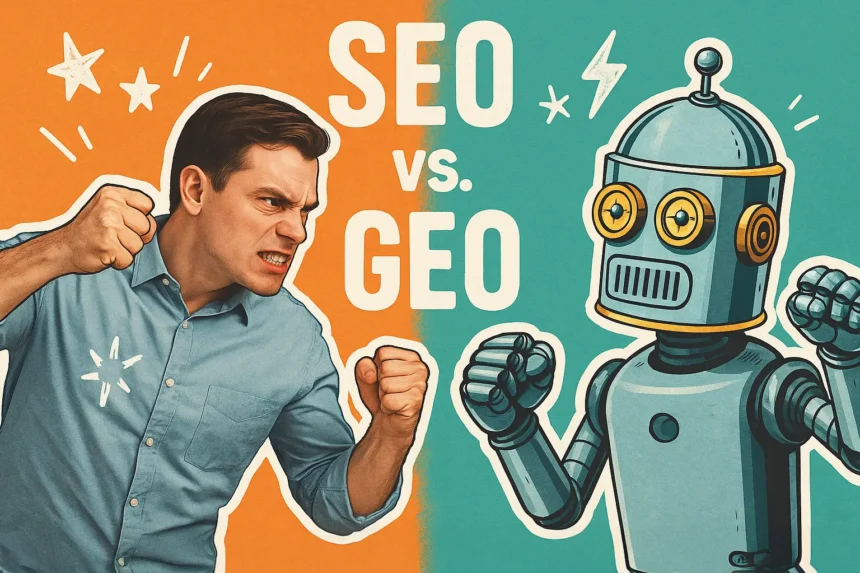
SEO focuses on ranking your content in traditional search results, while GEO targets inclusion in AI-generated answers. Both strategies complement each other, enhancing visibility and user engagement across different search formats.
Search doesn’t always look like a list of blue links. Alongside classic results, you’ll often see AI-generated answers that summarize the web and sometimes cite a handful of sources.
- SEO vs GEO: What’s the Difference (and why both matter)
- How Generative Engines Choose Sources (plain-English model)
- What to Publish for GEO: A lightweight content plan
- A) Canonical Explainers
- B) Evidence-Backed Guides
- Make Content “Machine-Readable” (without killing readability)
- Technical & Entity Signals that Support GEO
- Measurement & Workflow: Know if GEO Is Working
- You don’t choose between SEO and GEO; you stack them
- Further Reading
That’s where GEO, Generative Engine Optimization, comes in. While SEO aims to rank your pages in traditional results, GEO aims to get your content included or cited inside AI answers across Google’s AI Overviews and AI Mode, Bing Copilot Search, ChatGPT Search, Perplexity, and others.
This beginner-safe guide explains how SEO and GEO differ, how generative engines pick sources, what to publish, how to make content “extractable,” which signals support attribution, and how to measure outcomes with simple, reliable metrics.
SEO vs GEO: What’s the Difference (and why both matter)
SEO targets the classic results page: rank your content for relevant queries so users click to your site. Success is measured by rankings, clicks, and conversions.
GEO targets AI-generated answers: help engines use and credit your content inside a synthesized response. Success is measured by answer citations, mention share, assisted visits, and implied exposure (your brand is named even when the user doesn’t click).
They’re complementary, not competing. SEO builds durable discovery. GEO adds a second exposure layer where the answer itself is assembled for the user.
In practice, you’ll keep your SEO foundations (helpful content, clean information architecture, fast pages) and add a GEO layer: concise definitions, evidence-backed guidance, labeled comparisons, and fresh references that are easy for models to quote and attribute.
SEO vs GEO: goals, content style, and success metrics
| Aspect | SEO (classic) | GEO (generative) |
|---|---|---|
| Primary aim | Rank pages for queries | Be included/cited inside AI answers |
| Typical user behavior | Scans links, clicks to visit | Reads a synthesized answer, may click sources |
| Winning content | Comprehensive, well-structured pages | Clear, quotable facts; concise steps; current evidence |
| Signals that help | Relevance, usability, authority | Attribution clarity, recency, entity consistency |
| Success metrics | Rankings, organic clicks, conversions | Answer citations, mention share, assisted visits, implied exposure |
Note: Citation cards and link placement vary by engine and query. Expect changes to layout and the number of sources shown over time.
How Generative Engines Choose Sources (plain-English model)
Generative engines build answers in three stages:
1) Understand the question (intent).
Is the prompt a quick definition, a how-to, a comparison, or a nuanced decision?
Queries that imply synthesis (“X vs Y,” “best way to…,” “pros/cons with examples”) are prime GEO territory.
2) Retrieve and ground.
Engines fetch high-quality pages to anchor the answer. They tend to prefer sources that are reliable, clear, and recent, with content presented in extractable formats: explicit definitions, numbered steps, labeled tables, and named entities (people, organizations, products, standards).
3) Attribute and present.
Many engines surface citations or expandable source cards. Pages that offer verifiable claims and concise, well-labeled sections are more likely to be cited.
Buried facts, ambiguous assertions, or stale data reduce your odds.
Three beginner truths:
- Recency matters on fast-changing topics. Show a meaningful “Last updated” date and actually update.
- Entity clarity (consistent brand, author, and product identity) helps engines assign credit.
- Extractability (quotable blocks, tables, checklists) makes your content easy to reuse accurately.
What to Publish for GEO: A lightweight content plan
Start with queries where you have a right to win, the topics your brand leads day-to-day. Publish two high-leverage page types:
A) Canonical Explainers
Short, precise pages that define a term or framework in your niche.
- Open with a one-sentence summary (“In short: …”).
- Provide a clean definition, 1–2 examples, and a key-facts box.
- Cite sources for any figures or standards.
- Add a visible “Last updated” near the summary for time-sensitive topics.
B) Evidence-Backed Guides
Mid-length pages that answer “how to” or “best practice” with real-world specifics.
- Use numbered steps and a compact checklist.
- Include worked examples (mini case snippets).
- Add a short “Why this works” paragraph referencing known standards or studies.
A simple cadence: ship one explainer and one guide per month. Refresh quarterly if facts or tools change.
GEO-friendly page patterns (templates you can replicate)
| Page type | Structure | GEO-friendly traits |
|---|---|---|
| Canonical explainer | Summary → definition → examples → key-facts box | Quotable opening, plain-English definition, fresh references |
| Comparison (“X vs Y”) | Criteria table → bullet pros/cons → short verdict | Labeled rows, neutral tone, current differences |
| How-to mini-guide | 5-7 numbered steps → checklist → pitfalls | Action verbs, step summaries, practical cautions |
| Decision guide | If/then tree → examples → next steps | Explicit criteria, real use cases, links to evidence |
Make Content “Machine-Readable” (without killing readability)
GEO success isn’t just what you say; it’s how you package it for reuse. Keep pages human-first, then add structure that machines reliably understand.
- Lead with the answer. A concise summary box creates a perfect quote target.
- Use consistent names for entities. Keep brand, product, and author names identical across your site; add author bios and an “About” page to reinforce expertise.
- Structure with labels. Clear H2/H3s that match subtopics; tables with headers; numbered steps; glossary sections for definitions.
- Show recency. Place “Last updated” near the summary box for time-sensitive subjects.
- Caption visuals. Short captions on charts/diagrams can be quoted; ensure alt text is descriptive.
- Link to primary sources. Outbound links to standards, research, and official docs help engines (and humans) verify claims.
- Use schema where it fits. Article, HowTo (only for real steps), Product, Organization, Person, and occasionally FAQ. The goal is identity and context, not a guaranteed badge.
On-page “extractability” checklist
| Element | Why it helps | Quick win |
|---|---|---|
| One-sentence summary | Gives models a clean quote | Add “In short:” at the top |
| Definition block | Anchors terminology | Bold term + 1–2 lines |
| Criteria/steps tables | Clear, scannable structure | Add header labels; keep rows tight |
| Fresh references | Supports recency/credibility | Update bottom “Sources” quarterly |
| Author & about pages | Boosts attribution confidence | Link author → bio → organization |
Pro tip: keep paragraphs to 2–4 sentences and use subheads every ~200–300 words for easy scanning.
Technical & Entity Signals that Support GEO
GEO rewards attribution clarity. These simple technical habits help engines identify, trust, and reuse your content:
- Define your entity. Publish a stable Organization page (your entity home) with consistent name, description, and logo.
- Cross-link authors ↔ organization. Every author page should link to the Organization page and back, reinforcing provenance.
- Use clean, descriptive URLs. Short slugs that mirror headings are easier to cite and share.
- Optimize performance. Fast, mobile-friendly pages render reliably for crawlers and retrieval systems.
- Cite what you cite. When you use stats, include the source, year, and a brief context note. Verifiable claims get reused more.
- Be consistent off-site. Align your brand identity across LinkedIn, Wikipedia/Wikidata (if relevant), and trusted directories. Cross-web consistency strengthens entity disambiguation.
Bottom line: if a model lifted your summary paragraph, could a human verify the claim and provenance in seconds? If yes, you’re GEO-ready.
Measurement & Workflow: Know if GEO Is Working
Because AI answers may satisfy a query without a click, GEO measurement must look beyond classic SEO metrics. Use this lightweight, repeatable plan:
1) Track citations and mentions across engines
Maintain a weekly spot-check sheet for 10–20 cornerstone queries. For each engine (AI Overviews/AI Mode, Copilot Search, ChatGPT Search, Perplexity), record whether your brand or URL appears in the generated answer’s sources or “more” cards.
2) Cited-Answer Share (CAS)
Add a single KPI to summarize progress: CAS = % of tracked cornerstone queries where your brand appears as a cited source in any engine’s generative result.
Break it down by engine to spot where you’re winning or absent.
3) Assisted visits and conversions
Even when users read the AI answer first, they often click for depth.
Watch entrance paths to your explainers and guides, then monitor on-page behavior (time, scroll, checklist downloads, sign-ups, inquiries).
Attribute “assisted” outcomes to GEO when the first touch is an AI answer source.
4) Freshness and update velocity
Keep a “last updated” log for every canonical explainer and guide. GEO favors maintained pages. Aim to refresh time-sensitive assets quarterly or whenever a notable policy, tool, or standard changes.
5) Competitive gaps
In your spot checks, note which competitor pages get cited and why (often they offer a tighter definition, a current table, or a cleaner checklist).
Add those elements to your page while preserving your POV.
6) 60-day launch cadence
- Days 1–7: Pick 10–15 “right to win” queries.
- Days 8–21: Ship three pages (1 explainer, 1 comparison, 1 how-to).
- Days 22–30: Entity polish (author bios, org page, URL cleanup, performance).
- Days 31–45: Spot-check presence; log CAS and notes by engine.
- Days 46–60: Update with missing facts/examples; add one new explainer; revisit your measurement sheet.
You don’t choose between SEO and GEO; you stack them
Classic SEO ensures your best pages can be found. GEO ensures your best ideas can be used and credited inside AI-generated answers.
For beginners, the roadmap is straightforward: publish concise, verifiable content; structure it for easy quotation; keep entity details consistent on and off your site; and measure citations, CAS, assisted visits, and implied exposure alongside traditional SEO metrics. Interfaces and layouts will keep evolving, but quality information, clean structure, and steady upkeep will keep earning you visibility, whether users click links or read the answer where it’s assembled.
Further Reading
AI Features and Your Website, Google Search Central
Official guidance on how AI Overviews and AI Mode include content, with tips to improve inclusion, clarity, and user value.
https://developers.google.com/search/docs/appearance/ai-features
Succeeding in AI-Driven Search, Google Search Central Blog
Practical advice for making content useful to AI features: clarity, freshness, helpful structure, and how links and citations may appear.
https://developers.google.com/search/blog/2025/05/succeeding-in-ai-search
Introducing Copilot Search in Bing, Microsoft Bing Blog
Overview of Copilot Search blending classic and generative results, with cited sources and summaries users can expand for context.
https://blogs.bing.com/search/April-2025/Introducing-Copilot-Search-in-Bing
Introducing ChatGPT Search, OpenAI
Explains how ChatGPT Search surfaces concise answers with relevant sources, helping publishers understand opportunities for inclusion.
https://openai.com/index/introducing-chatgpt-search/
What Is Generative Engine Optimization (GEO)?, Search Engine Land
Beginner explainer of GEO, why it matters, and how to align content with AI answer engines that cite and summarize sources.
https://searchengineland.com/what-is-generative-engine-optimization-geo-444418
Generative Engine Optimization (GEO) Guide, Foundation Marketing
Field guide to earning citations in AI answers across engines with examples, page patterns, and a repeatable measurement plan.
https://foundationinc.co/lab/generative-engine-optimization