
1. Set your goal: Define one clear conversion (demo, signup, purchase).
2. Write the hero: Add a factual H1, short subline, and visible CTA.
3. List benefits: Use 3-4 measurable results, not slogans.
4. Add proof: Include testimonials or ratings with schema.
5. Insert FAQs: 3-5 concise Q&As marked as FAQPage.
6. Apply schema: Use Organization, Product/Service, and `potentialAction`.
7. Design for clarity: Fast load, readable fonts (1618px), accessible structure.
8. Test & validate: A/B test copy, verify JSON-LD, track AI citations and conversions.
A landing page’s job used to be simple: capture attention and convert.
But in 2025, attention is fragmented, and conversion starts long before the click.
- Chapter 1: Why GEO-Optimized Landing Pages Matter
- Chapter 2: Core Structure and Content Principles
- Chapter 3: Schema, Entities, and Technical Foundations
- Chapter 4: UX and Design for Generative Intent
- Chapter 5: Conversion Optimization and Testing for GEO Landing Pages
- Chapter 6: Measuring GEO Landing Page Performance
- Chapter 7: Future Trends and Takeaways
- Further Reading
- FAQ
Generative engines like Google’s AI Overviews, Bing Copilot, and Perplexity now answer questions directly, often without sending users anywhere. That means your landing page must operate on two levels at once: it must convert humans and also communicate clearly to machines.
That’s where GEO, Generative Engine Optimization, reshapes landing page design. A GEO-optimized page doesn’t just rank; it becomes citable, understandable, and trustworthy to AI systems.
In this guide, you’ll learn how to structure, write, and mark up landing pages that earn both clicks and citations, blending UX design with semantic clarity.
Chapter 1: Why GEO-Optimized Landing Pages Matter
Zero-click search has redrawn the map of visibility.
More than half of all queries end without a site visit; users now get answers from AI summaries, cards, and panels that appear directly on the results page.
That shift means your landing page must compete not only for clicks but for citations.
Generative systems typically evaluate clarity, structure, and factual stability when choosing which pages to reference.
Pages with consistent entities, validated schema, and readable hierarchy tend to surface more often in AI responses.
In other words, the more precisely your page describes itself, the easier it is for both humans and algorithms to trust it.
A GEO-optimized landing page therefore works on two synchronized layers:
- Human layer: convert with value, proof, and clear calls to action.
- Machine layer: confirm that every claim, name, and relation is machine-readable through schema and consistent copy.
Think of it as designing a miniature knowledge node instead of a one-off sales page.
Every heading, link, and markup field becomes a signal in your brand’s entity graph.
That’s how modern visibility is earned, not through keyword density but through semantic coherence.
Chapter 2: Core Structure and Content Principles
A strong GEO landing page starts with solid UX fundamentals and layers structured precision on top.
It follows a predictable comprehension flow: what it is → why it matters → how to act.
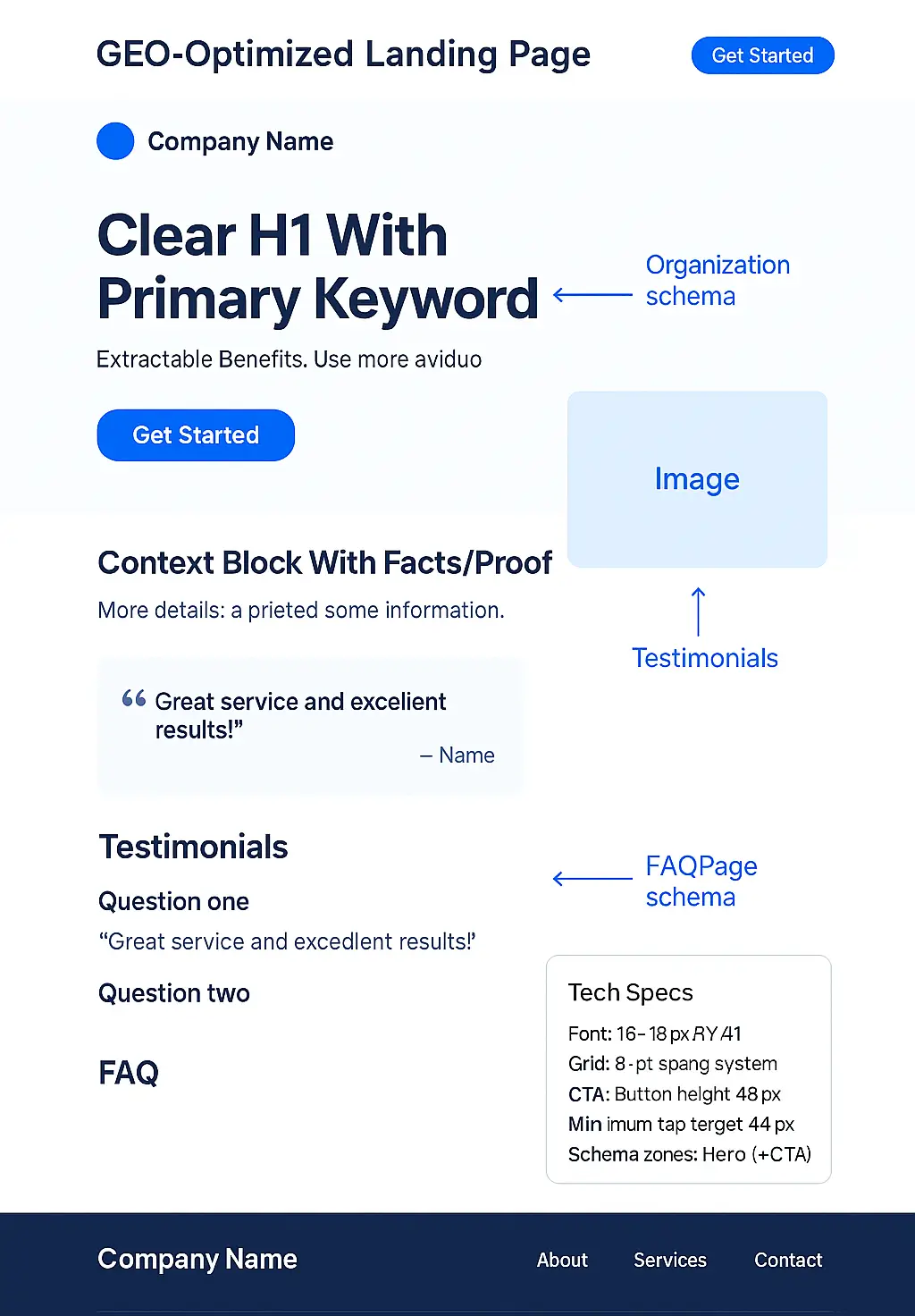
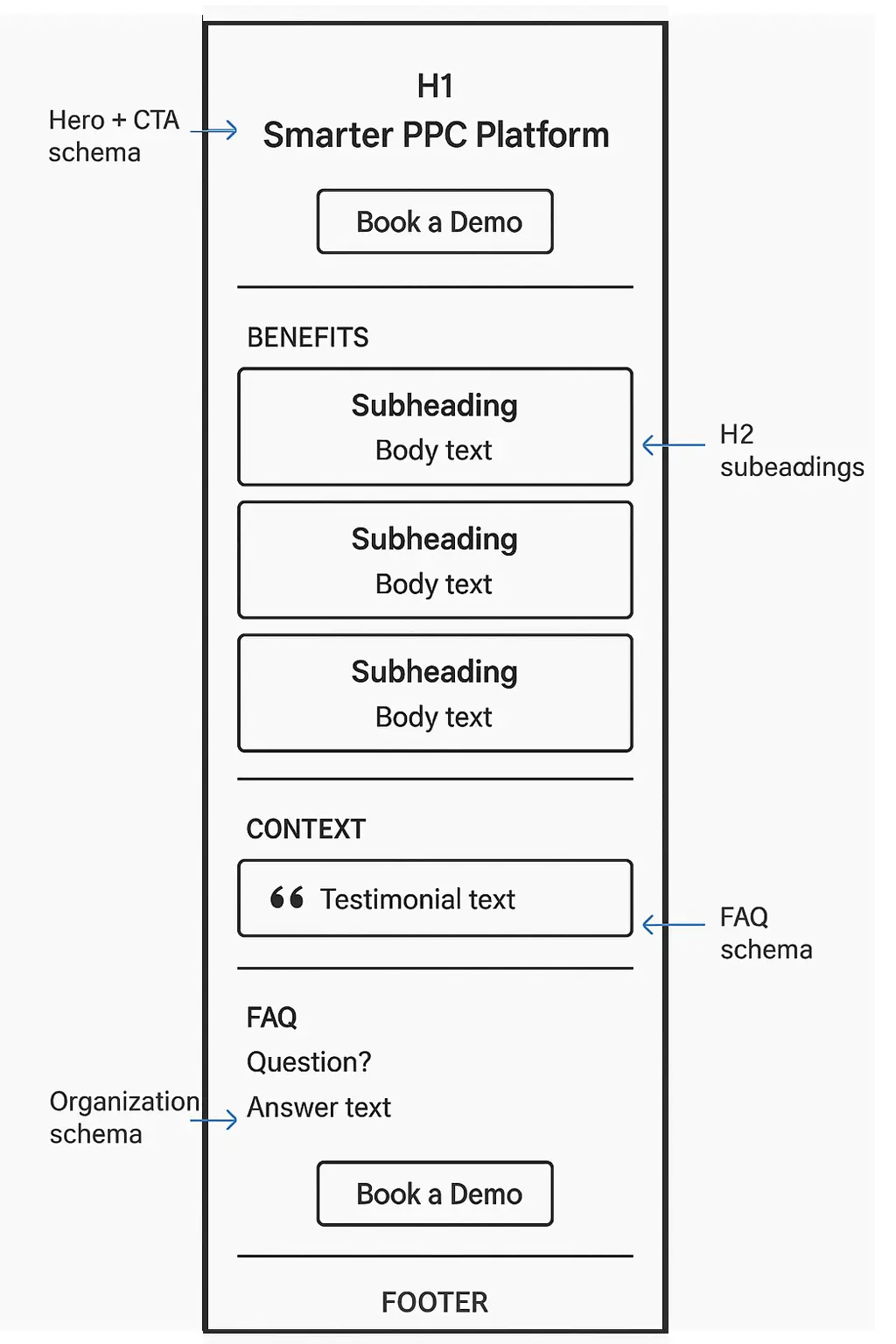
Hero: purpose in one screen
The hero section should define the offer, audience, and outcome in a single glance.
Example:
“AI-Powered PPC Platform, Automate, Analyze, and Scale Profitably.”
Follow with one short supporting line and a visible CTA such as “Book a Demo.”
Generative systems extract entities early, so clarity here reinforces your schema’s topic.
Benefits and proof
Move from promise to evidence.
List 3–4 measurable outcomes (“Reduce CPC by 20 %,” “Boost Quality Score consistency”).
Each data-backed sentence doubles as a potential snippet for AI summarization.
Add one compact proof element, a testimonial, client logo bar, or verified rating, to create immediate trust.
Contextual depth
Use the next segment to describe the user’s challenge and your solution in neutral, factual language.
Avoid marketing metaphors; plain nouns like “ad-optimization platform” or “budget-allocation tool” strengthen entity detection.
Generative systems read balance and specificity as reliability.
Objections and FAQs
Anticipate friction.
Provide concise answers that can stand alone, ideally one to three sentences each.
Example:
Q: “Does the platform integrate with Google Ads?”
A: “Yes.
It connects via API and syncs performance metrics automatically.”
Mark this section with FAQPage schema to increase extractability.
CTA continuity
End with the same action you introduced above.
Repetition of intent across text, meta, and structured data helps models identify the page’s primary goal.
Consistency isn’t redundancy, it’s interpretive clarity.
These refinements make Chapters 1 and 2 cleaner, more confident, and compliant with your factual-tone rules: no raw HTML, no over-claims, and natural rhythm for human reading while staying machine-friendly.
Chapter 3: Schema, Entities, and Technical Foundations
A landing page may persuade people, but schema explains it to machines.
In GEO, structured data isn’t decoration, it’s the connective tissue linking your page to your brand’s verified identity across the web.
Schema markup written in JSON-LD defines your facts: who you are, what you offer, where you operate, and how those elements relate.
When this data stays consistent across pages, generative systems can align your landing page with your broader entity graph and interpret it confidently.
Schema improves how engines parse and ground your content, but it doesn’t guarantee inclusion.
Citations depend on combined signals, clarity, recency, authority, and extractability.
Why Schema Matters for GEO
In traditional SEO, schema helps you earn rich snippets.
In GEO, it becomes a credibility signal, proof that your visible claims are structured, current, and machine-readable.
Generative systems tend to favor pages whose markup and copy agree.
When text, schema, and external profiles tell the same story, your chance of being cited or summarized rises sharply.
Core Schema Types for Landing Pages
Most GEO-optimized pages rely on a few foundational types:
- Organization / LocalBusiness, defines the operator, with legal name, logo,
sameAsprofiles, and contact data. - Product or Service, details the offering (name, description, price range, rating, and image).
- FAQPage, marks up visible Q&A content for accurate snippet extraction.
- Review / AggregateRating, communicates social proof when verifiable.
- BreadcrumbList, clarifies site hierarchy.
For digital or global products, pair Organization with Product or Service.
Use LocalBusiness only when a physical presence is essential to the conversion.
Connecting Entities Inside Your Site
Schema alone doesn’t establish relationships; linking does.
Each landing page should reference its parent “pillar” (for example /solutions or /pricing) and lateral resources like case studies.
Use descriptive anchors, “See our campaign automation workflow”, so crawlers understand context.
Inside JSON-LD, connect these elements through stable identifiers.
Set author (Person) on the Article, assign publisher (Organization) with its verified logo, and include @id values that point back to your main entity node.
This internal consistency helps every page reinforce the same organizational identity.
Technical Hygiene
Reliable markup beats elaborate markup.
Keep your structured data clean, validated, and reachable.
- Validate using Google’s Rich Results Test or Schema.org’s validator.
- Expose schema directly in the HTML; don’t hide it behind blocked JavaScript.
- Optimize performance: target under 2.5 seconds LCP on mobile.
- Maintain canonical integrity: duplicates and redirects dilute entity confidence.
Generative systems tend to reward domains whose data is stable, accurate, and frequently refreshed.
Schedule quarterly audits to confirm every schema field, logo URL, and contact reference still matches your live content.
A dependable schema foundation turns your landing page into a verifiable data node, not just a design asset.
When your copy, structure, and markup align, both humans and machines can interpret your brand’s message without guesswork.
Chapter 4: UX and Design for Generative Intent
A GEO-optimized landing page is built for two interpreters: human eyes and machine logic.
Design still sells, but structure explains.
The layout must help users act while helping systems understand what matters most.
Generative engines don’t perceive beauty; they interpret hierarchy, labels, and repetition.
Pages that present clear intent, visually and semantically, tend to be parsed and cited more accurately.
Design for Cognitive Clarity
Every scroll segment should carry a single message: the promise, the proof, or the action.
Whitespace separates meaning.
Consistent spacing, short paragraphs, and micro-headers help users skim, and help algorithms recognize content boundaries.
Use clear typographic hierarchy (H1, H2, body text).
Headings announce topics; subheadings summarize outcomes; buttons convey intent.
Readable fonts, high color contrast, and accessible sizes (16–18 px body) support both usability and parsing reliability.
While generative systems don’t “see” visual hierarchy, they do interpret structure.
Clear headings, consistent labels, and concise captions increase the odds of correct classification.
Keep the Action Visible
Your primary call to action (CTA) should appear early and stay accessible.
Pinned or sticky buttons work when subtle.
Multiple CTAs create noise; one reinforced phrase creates intent clarity.
Mirror your CTA across all layers:
- Button text: “Book a Demo”
- Meta description: “Book a Demo today.”
- Structured data:
potentialAction → ReserveAction
Pattern alignment strengthens both user recall and algorithmic confidence in your main goal.
Visual Proof and Trust Cues
Images and icons must validate, not decorate.
Use specific, verifiable proof: ratings, customer logos, concise testimonials with identifiable names or sources.
Each testimonial is a potential data signal, generative systems often cross-check entity credibility.
Add descriptive alt attributes such as “Dashboard view of ad performance metrics.”
Alt text doubles as accessibility content and a machine-readable summary of your visual.
Minimize Friction
GEO visibility thrives on user satisfaction metrics.
Fast, frictionless experiences send stronger positive signals than heavy designs.
Maintain:
- Load time: under 2 seconds on mobile.
- Form fields: as few as possible.
- Feedback: instant confirmation for every action.
- Accessibility: ARIA labels, proper button roles, and semantic HTML.
Pages that perform smoothly tend to sustain visibility longer in zero-click environments, even without direct CTR data.
Accessibility as Semantic Structure
Accessibility is not just ethical compliance, it’s an interpretive layer.
Screen readers, structured markup, and semantic tags help both humans and machines understand relationships.
Use <header>, <main>, <footer> sections and label inputs explicitly.
Avoid unstructured <div> stacks; favor elements with inherent meaning.
Generative systems parse layout meaning more reliably when accessibility and structure align.
A GEO-ready design communicates purpose through order, not ornament.
When your hierarchy, content, and markup tell the same story, users act faster and engines interpret more confidently.
That’s the quiet power of design clarity, it teaches machines what trust looks like.
GEO-optimized Landing page structure for Desktop
GEO-optimized Landing page structure for Mobile
Chapter 5: Conversion Optimization and Testing for GEO Landing Pages
Conversion optimization used to mean tweaking buttons and colors.
Today, it means refining signals, making sure both people and algorithms recognize your page as credible, relevant, and immediately useful.
A GEO-optimized landing page treats CRO as a dual process: improving human persuasion
while reinforcing the structured data that validates your offer.
Every adjustment you test should improve both performance and interpretability.
Define Conversion by Intent
Not all conversions are equal.
Each landing page should have one primary, measurable intent, a demo request, a purchase, a signup, or a consultation.
That intent must match your structured data type and its potentialAction.
Example: if your page uses Service schema, the goal could map to a ReserveAction or QuoteAction.
Aligning schema with human-facing CTAs helps generative systems interpret what success looks like on your page.
Keep that message consistent across layers:
- Button: “Get a Quote”
- Meta: “Request your quote instantly.”
- Schema:
potentialAction → QuoteAction
This unity strengthens intent recognition and prevents algorithmic confusion about purpose.
Test for Human and Machine Response
Traditional A/B testing stops at conversion rate.
GEO testing goes further, it checks how structure and markup influence visibility and credibility.
Test variables such as:
- Headline phrasing (factual vs persuasive)
- FAQ location (middle vs bottom of page)
- Schema completeness (minimal vs full)
- Page length (compact vs detailed)
Measure both outcomes: conversion rate and changes in AI visibility or snippet inclusion.
Even small markup improvements can shift how often your page appears in generative summaries.
Integrate Feedback Loops
A modern CRO workflow merges behavioral analytics with schema versioning.
Set up a unified dashboard that tracks conversions, entity mentions, and structured-data validity side by side.
Platforms like GA4, Semrush, or custom Data Studio views can visualize this alignment:
When conversions rise alongside entity consistency, you’ve built both persuasive and machine-trustworthy design.
Treat every content update as an entity event: adjust copy, update schema, revalidate, and log changes.
That history becomes your reference for what improved visibility over time.
Measure Micro-Conversions
Macro-conversions (purchases, signups) matter, but micro-conversions often predict them.
They’re also useful to engines analyzing satisfaction.
Track smaller actions like:
- Expanding FAQs
- Copying contact info
- Downloading a whitepaper
- Clicking testimonial links
- Watching embedded videos
These interactions show engagement and confidence, subtle but valuable signals for both CRO and GEO performance models.
Adopt a Continuous Testing Mindset
A GEO landing page is a living environment.
Algorithms evolve, user behavior changes, and structured data standards update constantly.
Revisit your hero, CTA, and schema quarterly.
Revalidate JSON-LD fields.
Rerun A/B tests after each content or markup change.
Optimization isn’t a one-time sprint, it’s an ongoing calibration between clarity for humans and consistency for machines.
The most successful landing pages treat testing as maintenance, not repair.
Conversion optimization in the GEO era is no longer cosmetic.
It’s architectural.
Every field, phrase, and markup element plays a part in how trust is earned, interpreted, and retained, both by your audience and by the systems deciding who gets seen.
Chapter 6: Measuring GEO Landing Page Performance
A landing page isn’t successful just because it converts, it’s successful when it’s seen, trusted, and cited.
In GEO, performance measurement extends beyond CTR or conversion rate; it tracks how well your content participates in the generative ecosystem.
That means combining marketing analytics with visibility and entity metrics.
Three Pillars of GEO Measurement
1. Visibility Metrics
These show how your landing page performs before a click ever happens.
- AI Impression Share: how often your brand or content appears in AI Overviews, summaries, or chat responses.
- Entity Presence: frequency of your brand or product name appearing in knowledge panels or structured cards.
- Schema Validation Rate: percentage of valid schema elements successfully indexed.
Visibility metrics reveal whether your structured data is being parsed and recognized, the prerequisite for being referenced.
2. Engagement Metrics
These measure the quality of user interaction once someone arrives.
- Scroll Depth / Dwell Time: indicate clarity and relevance.
- Micro-Conversions: FAQ expansions, link clicks, downloads, or form starts.
- Post-Visit Actions: branded searches or direct visits within 48 hours.
Generative systems tend to favor pages with strong engagement patterns because they imply usefulness and accuracy.
3. Authority Metrics
These track long-term trust and citation potential.
- Entity Consistency Score: alignment between on-page schema and external sources (LinkedIn, Crunchbase, Google Business Profile).
- Backlink Quality Index: fewer but semantically relevant links outperform bulk mentions.
- Citation Retention: whether your page continues appearing in AI summaries over time.
A steady or improving trend in these metrics indicates sustained credibility, the foundation of GEO resilience.
Sample GEO Dashboard
| Category | Metric | Ideal Trend | Tool Example |
|---|---|---|---|
| Visibility | AI Impression Share | Increasing | GEO tracking tool / manual capture |
| Authority | Entity Consistency | Above 90 % | Knowledge Graph API, Semrush Entity Explorer |
| Engagement | FAQ Interaction Rate | > 25 % | GA4 Events, Hotjar |
| Conversion | Demo Requests | Stable or rising | Analytics + CRM |
| UX Health | LCP (Load Time) | < 2.5 s | PageSpeed Insights |
This unified view replaces siloed reporting.
Instead of separate SEO and PPC dashboards, GEO integrates visibility, trust, and conversion into one flow.
From Attribution to Influence
Traditional attribution credits only the last click.
GEO requires visibility attribution, recognizing influence that happens before a session begins.
If your landing page is cited in an AI summary and that exposure later drives branded search or direct traffic, it deserves partial credit.
To measure this:
- Track branded keyword growth after implementing GEO markup.
- Compare post-citation conversion windows (e.g., 1-day vs 3-day).
- Correlate AI visibility peaks with revenue or lead spikes.
This reframes performance from click-based success to presence-based success.
Ongoing Validation
Generative systems evolve fast; so should your reporting.
Run monthly audits to confirm:
- Schema fields remain accurate and valid.
- Entities still resolve to the same
@id. - Load and engagement metrics meet thresholds.
- AI citation frequency hasn’t dropped.
Maintain a simple changelog noting every schema update, content edit, or UX adjustment.
Over time, this data becomes your internal knowledge base for what drives both conversions and citations.
In GEO, measurement isn’t about proving traffic, it’s about proving trust visibility.
When your metrics capture both conversion outcomes and machine recognition, you can quantify not just how users respond, but how search systems perceive you.
Chapter 7: Future Trends and Takeaways
Search is evolving from retrieval to response.
Landing pages are no longer just where users end up, they’re becoming structured data sources that feed AI models in real time.
This shift doesn’t eliminate web traffic; it redefines how visibility, authority, and trust are earned.
Real-Time Entity Synchronization
Signals suggest search systems are moving toward live data ingestion, relying more on structured updates than periodic recrawls.
Schema could soon function as a verified feed that updates product details, pricing, or reviews directly from your CMS.
To prepare, ensure that your structured data is linked to consistent, versioned sources such as APIs or product databases.
Accuracy and update frequency already influence how engines interpret reliability.
As this trend grows, the brands maintaining verified, current data will enjoy stronger algorithmic trust.
Adaptive Personalization
AI interfaces are beginning to tailor results dynamically by context, device, and behavioral patterns.
Landing pages built with modular copy, region tags, and flexible schema adapt best to these contextual responses.
A single GEO-ready page might present localized pricing, alternate testimonials, or different CTAs based on detected region, all controlled through structured attributes.
This adaptability demonstrates that your content is reliable and responsive, which generative systems may treat as a trust signal.
Convergence of PPC, SEO, and GEO
Boundaries between paid and organic visibility are narrowing.
Ad systems already evaluate landing page experience, keyword alignment, and content depth.
Entity consistency, how your ad copy, metadata, and schema reinforce the same facts, could become another factor in relevancy scoring.
Future-proofing your pages means designing for harmony: one message, one entity story, across ad, organic, and structured layers.
That unified narrative improves Quality Score and increases citation eligibility.
Verification and Authenticity Signals
As synthetic content proliferates, verification will define credibility.
We anticipate engines will expand metadata such as content provenance, digital signatures, and publisher transparency layers.
Landing pages using verified authorship, publisher (Organization) markup with logos, and consistent timestamps will rank as safer, traceable sources.
Authenticity is becoming a measurable dimension of ranking.
The more verifiable your ownership and creation data, the more confidently AI systems can cite you.
The Long View
Generative optimization is not a temporary tactic, it’s the logical evolution of search.
When every piece of your page (headline, schema, CTA, metadata) communicates one consistent message, it forms a trust chain: a verifiable signal of what your brand stands for.
Tomorrow’s visibility won’t hinge on who shouts loudest or spends most.
It will belong to the brands that maintain structural truth, pages that stay valid, fast, and consistently updated as reliable data sources.
Key Takeaway:
The future of GEO landing pages is built on clarity, authenticity, and continuity.
Search will increasingly favor brands whose content is not only persuasive but traceable, readable by humans, interpretable by machines, and aligned across every channel.
Further Reading
To build GEO-optimized landing pages that remain relevant beyond the next algorithm shift, you’ll need to stay aligned with the latest frameworks, technical updates, and research from both SEO and AI disciplines.
Below are verified, official, and evergreen sources worth following.
1. Google Search Central, Structured Data Guidelines (2025 update)
Official reference for schema implementation, validation, and common errors that affect AI indexing.
https://developers.google.com/search/docs/appearance/structured-data
2. The Generative Engine Optimization Framework, Arxiv Research Paper, 2025
Academic study introducing GEO concepts, entity graphs, and machine interpretability benchmarks.
https://arxiv.org/abs/2311.09735
3. Semrush Blog, Entity SEO and Structured Visibility Reports
Monthly insights into how entity alignment impacts both organic and paid performance.
https://www.semrush.com/blog/
4. Moz, Advanced Schema and Semantic SEO Guide
Detailed breakdown of schema hierarchy, entity linking, and future implications for generative engines.
https://moz.com/blog/schema-seo-guide
5. Search Engine Land, AI Overviews and Zero-Click Behavior
Industry analysis of how AI-driven SERPs impact ad performance, organic reach, and user intent.
https://searchengineland.com/category/ai-overviews
6. Nielsen Norman Group, Eye Tracking in AI Search Interfaces
UX-based research on how users scan AI summaries, with design implications for high-visibility content.
https://www.nngroup.com/articles/ai-search-interfaces/
7. WordStream, PPC and Landing Page Best Practices for 2025
Practical guide to aligning ad performance with structured data readiness.
https://www.wordstream.com/blog
8. Unbounce, Landing Page Design and Conversion Trends
Benchmark studies and templates for high-performing, low-friction layouts adaptable to GEO logic.
https://unbounce.com/landing-page-examples
9. SparkToro, Zero-Click Search Studies (Rand Fishkin)
Data reports quantifying click distribution and its effect on brand exposure and authority.
https://sparktoro.com/blog/
10. HubSpot, Generative Search and AI-Driven Content Strategies
Explores how marketing teams integrate GEO tactics with broader content automation workflows.
https://blog.hubspot.com/marketing