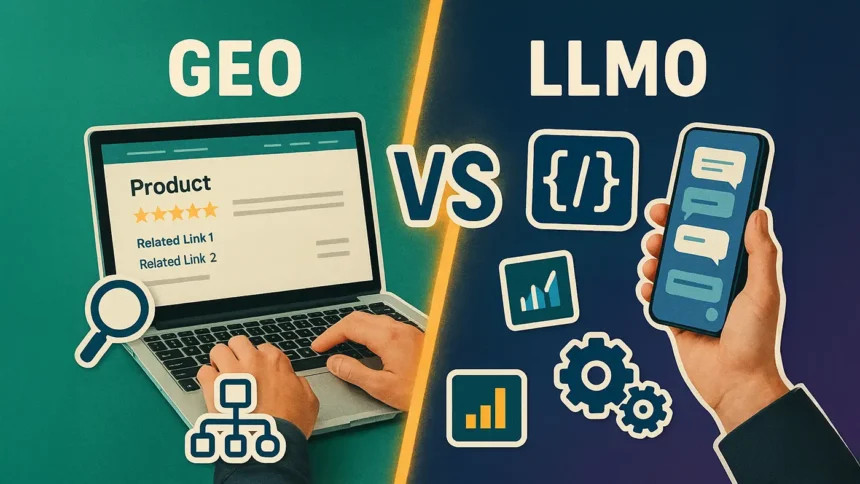
What happens when e-commerce category pages stop ranking and start reasoning?
Search visibility has moved from lists of blue links to generative answers where engines summarize, cite, and contextualize instead of simply displaying rankings.
GEO (Generative Engine Optimization) ensures your brand is visible across these new AI-driven results.
LLMO (Large Language Model Optimization) ensures your pages are understood by those systems, making your data both interpretable and retrievable.
Category pages now act as structured narratives, not static directories.
In the era of AI Overviews, Bing Copilot, and Perplexity, every heading, schema, and sentence contributes to how models reason about your brand.
The Shift from SEO to GEO
For twenty years, e-commerce optimization was defined by SEO: rank high, attract clicks, convert.
But generative search changed the rules.
AI engines no longer display ten blue links, they summarize, cite, and contextualize information drawn from trusted sources.
GEO (Generative Engine Optimization) expands visibility from keyword ranking to citation presence.
The question is no longer Can Google crawl and index my page?
but Will ChatGPT, Gemini, or Perplexity include and credit my content in its synthesized answer?
In this new landscape, a category page like Running Shoes must act as an entity network, not a keyword hub. Products, reviews, and brand context must interlink coherently.
AI systems evaluate how concepts connect, not just how often terms repeat.
If your schema is inconsistent, filters redundant, or copy thin, you disappear from the reasoning layer even if you still rank on the search layer.
GEO Metrics that Matter
Instead of traditional CTR or position, monitor:
- Generative impressions, how often your content appears inside AI summaries.
- Citation share, what percentage of AI answers mention your brand.
- AI referral traffic, sessions arriving through generative links.
These are not vanity metrics; they measure your share of machine attention, the visibility that occurs before a click.
Why GEO Builds on SEO
GEO doesn’t replace SEO; it builds on it. Crawlability and structured metadata still feed discovery, but GEO ensures that discovery converts into recognition.
SEO finds you; GEO makes sure engines quote you.
The most visible e-commerce brands now design category pages as knowledge graphs: internal linking, clean schema, explicit relationships between category, brand, and attribute.
When your “Women’s Boots” page ties materials, care guides, and sustainability tags into structured schema, AI systems can confidently ground and cite that information.
Visibility has shifted from ranking to reasoning. Those who master GEO don’t chase algorithms, they communicate clarity to the systems that shape the new search economy.
Where LLMO Enters the Picture
If GEO governs visibility, LLMO (Large Language Model Optimization) governs understanding.
It ensures that when AI engines read your page, they interpret every element accurately, what’s a product, what’s a feature, and how it all connects.
Large language models don’t browse like humans; they parse text through tokenized context, mathematical patterns that rely on structure, schema, and repetition.
LLMO converts unstructured descriptions into interpretable entities.
It teaches a model that “Men’s Running Shoes” is a category, “Nike Pegasus 41” a model, and “carbon plate” a performance feature.
The LLMO Checklist
Start with structure, not style:
- Chunking: Split content into semantic blocks, brand, type, size, material.
- Schema: Use Product, BreadcrumbList, and ItemList markup consistently.
- Attribution: Add author names, publication dates, and context anchors.
- Consistency: Keep canonical entity names across pages, no “Pegasus 41” on one page and “Air Zoom Pegasus 41” on another.
These signals let models ground your content with precision. When structure drifts, grounding breaks, your brand might be mentioned but not credited.
Why LLMO Matters
You can’t earn GEO visibility if models can’t interpret your data.
LLMO turns your category pages from readable to reasoned, giving AI systems a clear map of meaning.
It’s how a model knows your “Trail Running” section belongs under outdoor performance rather than generic sportswear.
LLMO doesn’t chase rankings; it builds reliability, a consistent internal logic that models can reference and users can trust.
In the generative era, that reliability is the new relevance.
GEO vs LLMO: The Functional Divide
The easiest mistake in 2025 e-commerce strategy is treating GEO and LLMO as synonyms.
They’re connected but solve different visibility problems.
GEO is strategic, it governs where and when your brand appears inside generative search results.
LLMO is technical, it governs how your content is parsed, interpreted, and retrieved by models.
One manages exposure, the other manages comprehension.
Imagine the generative ecosystem as a pipeline:
- SEO + AEO form the foundation, they ensure discovery and relevance.
- LLMO forms the processing layer, it translates human copy into machine logic.
- GEO forms the output layer, it determines whether that logic becomes a visible citation.
Traditional search still crawls and ranks, but AI engines reason.
The competitive metric is no longer position #1, it’s citation frequency, the rate at which models reuse and credit your information across contexts.
The Generative Visibility Stack
| Layer | Purpose | Primary Focus | KPI to Track | Real-World Example |
|---|---|---|---|---|
| SEO | Discovery & indexing | Crawlability + meta data | CTR | Organic rank in classic SERP |
| AEO | Direct answers | Relevance + conciseness | Featured-snippet rate | Appears in Google AI Overview |
| LLMO | Model comprehension | Entity clarity + grounding | Retrieval hit rate | Brand interpreted correctly in ChatGPT |
| GEO | Generative visibility | Citation share + cross-engine presence | Generative impressions | Mentioned in Perplexity or Copilot |
Each layer feeds the next.
SEO ensures pages are findable.
AEO shapes their answer-readiness.
LLMO gives structure that models can reason over.
GEO converts that structure into credited visibility.
When one tier weakens, the chain breaks.
A “Women’s Boots” page might still rank, but if its schema is inconsistent, the AI may reference its content without citing the brand, a silent loss invisible to Search Console.
How the Divide Plays Out in Practice
- Google AI Overviews favor pages with schema clarity and strong entity relationships, an AEO + GEO synergy.
- ChatGPT Browse pulls from content with accurate metadata, clear authorship, and consistent formatting, LLMO precision.
- Perplexity AI weighs source reliability and redundancy before surfacing citations, GEO ranking logic.
In short:
- GEO ensures you appear.
- LLMO ensures you’re understood.
Together, they decide whether your information becomes the quoted truth or forgotten context.
Strategic Takeaway
Treat GEO and LLMO as a dual system: visibility depends on interpretability.
GEO measures presence; LLMO guarantees precision.
One without the other produces incomplete outcomes, visibility without grounding or comprehension without reach.
For e-commerce category pages, this duality defines competitiveness in 2025.
Your content must rank, reason, and render, all three.
LLMO shapes how engines perceive your data; GEO determines whether that perception becomes public.
Together they form the new visibility architecture where every brand competes not for clicks, but for citations within machine-generated reasoning.
Applying GEO on Category Pages
GEO isn’t a buzzword; it’s the operating system of modern visibility.
Where SEO focuses on discovery, GEO focuses on recognition, how and when your brand appears inside AI-generated summaries.
A category page is no longer a list of products; it’s a knowledge node that helps engines reason through relationships among categories, products, and brand values.
Google AI Overviews, Bing Copilot, and Perplexity now evaluate contextual coherence as heavily as keywords.
Your “Running Shoes” page must clearly connect to related topics such as “Men’s Fitness,” “Trail Gear,” and “Performance Footwear.”
That network of meaning determines whether AI systems treat your content as a trusted entity or generic noise.
The GEO Implementation Path
Following the GenSERP Operational Playbook, every e-commerce GEO rollout follows five practical phases:
- Audit & Discovery
Map existing entities, brands, products, attributes.
Check where your content already appears in AI Overviews or Perplexity, and identify missing exposure points. - Content Structuring
Build a logical hierarchy linking categories, buying guides, and reviews.
Each node must state why it exists, not just what it lists. - Attribution Optimization
Add author profiles, last-updated timestamps, and explicit brand mentions.
Generative engines cite what they can trust, and trust starts with visible authorship. - Generative Grounding
Test how your content surfaces in AI summaries.
Are you quoted by name, paraphrased, or ignored?
Use findings to reinforce entity relationships and metadata. - Measurement Loop
Track three core KPIs:- Generative impressions, appearances in AI answers.
- Citation share, percent of summaries referencing your site.
- AI referral traffic, sessions originating from those citations.
This closed loop turns visibility into a measurable cycle, discover → reason → cite → visit → improve.
GEO in Practice
Consider a store selling sustainable skincare.
Its “Organic Face Creams” page should include:
- A concise intro explaining what “organic” means in skincare (entity clarity).
- A linked guide about ingredient sourcing (contextual relevance).
- Structured schema for brand, certification, and product type (machine recognition).
Such elements give AI engines the connective tissue needed to mention your brand confidently when summarizing “best organic face creams.”
GEO rewards narrative structure, content that reads like a cohesive story of purpose and proof.
When pages are designed for extraction, not decoration, engines can summarize and attribute correctly.
That’s the new definition of visibility: being referenced accurately in the conversations that convert curiosity into credibility.
Example: Product + Breadcrumb Schema (for GEO)
Use a minimal, valid JSON-LD block that connects a product to its category and brand entity.
<script type="application/ld+json">
{
  "@context": "https://schema.org",
  "@type": "Product",
  "@id": "https://example.com/running-shoes#pegasus41",
  "name": "Nike Air Zoom Pegasus 41",
  "brand": {
    "@type": "Brand",
    "name": "Nike"
  },
  "category": "Running Shoes",
  "image": "https://example.com/images/pegasus41.jpg",
  "offers": {
    "@type": "Offer",
    "price": "129.99",
    "priceCurrency": "USD",
    "availability": "https://schema.org/InStock"
  },
  "aggregateRating": {
    "@type": "AggregateRating",
    "ratingValue": "4.7",
    "reviewCount": "312"
  },
  "isPartOf": {
    "@type": "BreadcrumbList",
    "itemListElement": [
      { "@type": "ListItem", "position": 1, "name": "Shoes", "item": "https://example.com/shoes" },
      { "@type": "ListItem", "position": 2, "name": "Running Shoes", "item": "https://example.com/running-shoes" }
    ]
  }
}
</script>
✅ This illustrates how entity hierarchy + structured data feed GEO:
the product, brand, and category are explicitly connected, exactly what AI Overviews and Perplexity use to build trustworthy summaries.
Executing LLMO for E-commerce
LLMO is where e-commerce pages stop being text blocks and start acting as data systems.
It’s not about adding content; it’s about structuring meaning so large-language models can interpret it without guessing.
While GEO drives exposure, LLMO drives comprehension, the difference between being mentioned and being represented correctly.
The Core Principle
Models like GPT, Claude, and Gemini interpret pages through semantic coherence.
They infer entities, attributes, and intent via markup, headings, and consistent segmentation.
Your task is to make those cues machine-obvious.
The clearer the structure, the higher your retrieval hit rate and entity recall, the two fundamental LLMO KPIs.
The LLMO Content Fitness Model
| Dimension | Description | How to Test | Success Signal |
|---|---|---|---|
| Readability | Concise, context-steady copy | Run a GPT summary test | Model paraphrases accurately |
| Chunk Quality | Logical sections by topic or brand | Semantic segmentation review | Clean extraction per chunk |
| Entity Linking | Schema + internal linking accuracy | Entity graph validation | Products and brands connected |
| Attribution Trace | Visible authorship + dates | AI citation audit | Brand credited properly |
| Topical Density | Distinct insights vs competitors | Overlap index check | Low redundancy, high originality |
These factors don’t just please crawlers, they train models to interpret your catalog as a coherent dataset.
From Readable to Reasonable
AI doesn’t read; it reconstructs.
If your “Trail Running Shoes” category maintains uniform structure, attributes like weight, terrain, cushioning, material, the model understands context.
If descriptions vary wildly, it detects noise.
LLMO filters that noise, defining what belongs in your brand’s entity graph and what doesn’t.
That clarity determines whether you’re cited as an authority or ignored as ambiguity.
LLMO in Action
- Schema Accuracy: Validate Product, ItemList, and BreadcrumbList schemas; missing or duplicated fields lower recall.
- Entity Consistency: Standardize brand and model naming; “Air Zoom Pegasus 41” ≠ “Nike Pegasus 41.”
- Authorship & Credibility: Use timestamps and bylines; AI values recency as reliability.
- Chunking Logic: Keep sections 80–150 words, each self-contained for retrieval clarity.
- Embedding Evaluation: Test pages in RAG environments; if key facts are lost in summaries, refine anchors.
Every improvement strengthens entity recall, how often models correctly recognize and quote your brand.
Executed correctly, LLMO transforms category pages into structured sources of truth.
It’s not about ranking higher; it’s about becoming machine-reliable.
That reliability fuels GEO: comprehension creates visibility, and visibility earns trust.
Together, they form the architecture of e-commerce relevance in the generative era.
Example: LLMO Chunking and Context Anchors
Show how to write category copy in logical, machine-friendly segments.
### Trail Running Shoes
Lightweight footwear built for uneven terrain and outdoor endurance.
Each pair features reinforced midsoles and weather-resistant uppers.

**Entity anchors:**
- Product Type: Trail Running Shoes
- Use Case: Outdoor Performance
- Material: Mesh + Rubber
- Audience: Men / Women
✅ Here the heading defines topic, the short paragraph gives semantic context, and the bullet anchors clarify entity roles.
When embedded in HTML (<section> + data-entity="trail-running"), LLMs can segment and retrieve this block cleanly, improving recall.
Why GEO and LLMO Must Coexist
Think of GEO and LLMO as the two sides of modern visibility: one governs exposure, the other governs interpretation.
Without both, your e-commerce ecosystem collapses, one makes you seen, the other makes you understood.
GEO is the public layer.
It measures how often your brand appears in generative results, Google AI Overviews, Bing Copilot, ChatGPT Browse, or Perplexity.
It’s visibility made measurable: impressions, citations, referrals.
LLMO is the cognitive layer.
It ensures models comprehend your content correctly, that your “Trail Running Shoes” are categorized as outdoor footwear, not generic sneakers; that “sustainable leather” maps to materials, not ethics copy.
It’s interpretability that prevents misrepresentation.
Together, they form a feedback loop: LLMO enables understanding, GEO amplifies that understanding into recognition.
The GEO–LLMO Feedback Cycle
The GenSERP Unified Framework defines this flow as a four-layer sequence:
- SEO → discovery and crawlability
- AEO → structured answer readiness
- LLMO → comprehension and entity grounding
- GEO → visibility and citation presence
Each layer feeds the next.
If your product schema is broken (LLMO gap), AI may find your page but misinterpret it.
If your entities are perfect but unseen (GEO gap), you’ll be understood, but invisible.
A strong pipeline demands both.
How It Works in Practice
- Google AI Overviews surface content with consistent schema and trusted entities, where LLMO clarity boosts GEO exposure.
- ChatGPT Browse favors sources with precise metadata and consistent authorship, LLMO precision creates citation stability.
- Perplexity AI filters by source redundancy and coherence, GEO reputation determines whether you make the final summary.
In every case, interpretability fuels inclusion.
Search engines still crawl, but AI engines reason, ranking by confidence rather than keyword density.
Visibility Through Interpretability
Being visible but misrepresented erodes trust.
Being correct but unseen wastes potential.
Only when comprehension and exposure converge does a brand achieve lasting visibility.
Teams mastering this dual system treat it as a visibility architecture, not a marketing tactic:
- SEO ensures you’re findable.
- LLMO ensures you’re intelligible.
- GEO ensures you’re cited.
The cycle turns static content into living data, retrievable, reusable, referable.
The most advanced e-commerce brands now track entity recall and citation share side by side, just as older teams tracked CTR and bounce rate.
Their visibility reviews look more like model-interpretation audits than keyword reports.
From Optimization to Alignment
Traditional optimization treated search engines as judges; GEO × LLMO treats them as collaborators.
Your content isn’t pitched at them, it’s co-authored with them.
Every schema, heading, and product detail becomes a handshake between human communication and machine reasoning.
This shift demands organizational alignment:
- SEO strategists maintain crawl paths and technical foundations.
- LLMO specialists refine schema, chunking, and data consistency.
- GEO analysts monitor citation share and generative referrals.
Together, they create content that ranks, reasons, and renders, optimized not only for search, but for synthesis.
The New Standard
GEO without LLMO is performance art, seen but shallow.
LLMO without GEO is a silent masterpiece, brilliant but unseen.
Combined, they build discoverability that thinks as well as it ranks.
The brands that thrive in 2025 won’t just publish pages, they’ll publish systems of understanding.
Every product, paragraph, and schema line becomes a node in a transparent network of meaning.
In the generative era, success isn’t measured by clicks alone, but by how clearly your content teaches machines to remember you.
Conclusion
Ecommerce visibility has entered its reasoning era.
SEO built the map. AEO taught engines to summarize.
LLMO made content interpretable. GEO made it visible across generative ecosystems.
When these layers align, your category pages evolve from product directories into knowledge entities, content that both humans and machines can trust, quote, and reuse.
In this AI-driven economy, your brand’s visibility depends not on volume but on clarity.
If GEO earns attention, LLMO earns understanding, and understanding, finally, earns citation.
Visibility is no longer about ranking higher.
It’s about being understood accurately in the conversations that shape every search.
Further Reading & Official References
OpenAI API Reference (2025), Complete guide to models, parameters, rate limits, and usage best practices.
https://platform.openai.com/docs/api-reference
Google Search Central: Structured Data Guidelines, Official schema rules, validation details, and updates relevant for AI Overviews and generative surfaces.
https://developers.google.com/search/docs/appearance/structured-data
Schema.org Vocabulary (latest release), The canonical resource for schema types and entity properties used by search and AI systems.
https://schema.org/docs/full.html
WordPress REST API & Security Handbook, In-depth guidance for building secure, reliable interactions when embedding AI workflows.
https://developer.wordpress.org/rest-api/
Strapi Webhooks & Lifecycles Documentation, Key reference for headless CMS users integrating content triggers with AI services.
https://docs.strapi.io/
Google Search Blog: AI Overviews & Entity Signals (2025), Engineering insights into how Google cites and prioritizes structured content in AI results.
https://developers.google.com/search/blog
OWASP API Security Top 10, Essential security guidelines for APIs, webhooks, and integrations, crucial when embedding AI in your CMS.
https://owasp.org/API-Security/
EU Artificial Intelligence Act Overview, Regulatory framework that impacts AI content disclosure, trust, and compliance considerations.
https://artificialintelligenceact.eu
FAQ
GEO compared to LLMO and Ecommerce Category Pages
| Aspect | GEO | LLMO | Ecommerce Category Pages |
|---|---|---|---|
| Visibility in Search | GEO enhances visibility across various AI-driven search platforms effectively. | LLMO focuses on improving how content is interpreted by AI models. | Ecommerce category pages require optimization for both human and AI users. |
| Content Interpretation | GEO promotes broader reach in search results through strategic visibility. | LLMO emphasizes the importance of accurate content understanding by engines. | Effective category pages balance user needs with AI requirements. |
| Citation Accuracy | GEO supports citation potential by increasing brand presence in search. | LLMO ensures that citations are accurate and relevant to the content. | Category pages must be structured to facilitate both engagement and visibility. |
| User Engagement | GEO can lead to higher user engagement through increased visibility. | LLMO aims to enhance user experience by ensuring clarity in content. | Engagement metrics are crucial for evaluating category page effectiveness. |
| SEO Impact | GEO's impact on SEO is significant due to its visibility strategies. | LLMO influences SEO by ensuring content is correctly interpreted by models. | SEO strategies must evolve to address both GEO and LLMO considerations. |
| Future Trends | GEO is likely to adapt to future AI search trends effectively. | LLMO will continue to shape how content is understood in search. | Future trends will require a blend of visibility and interpretability. |