


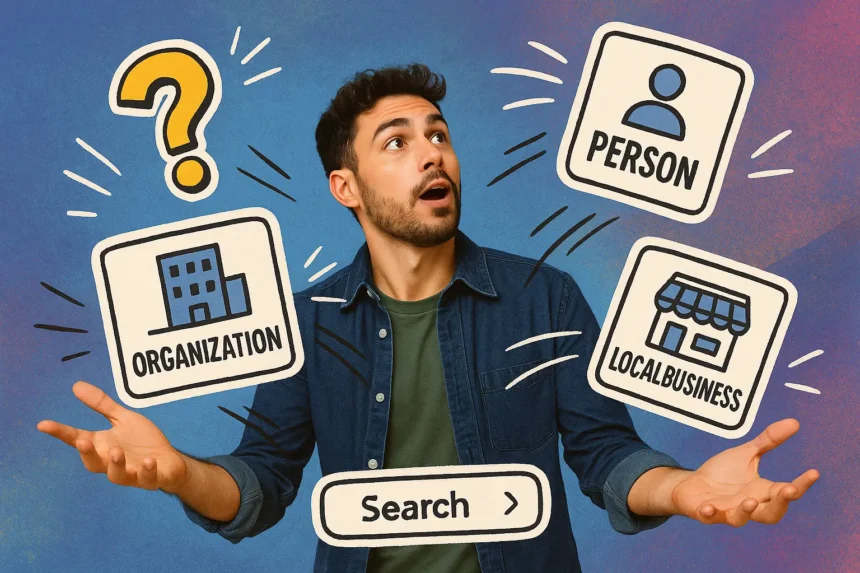
Establish a durable identity by publishing a clear entity home on your site, using the correct schema type, and linking to authoritative profiles for better search engine recognition and trust.
Entity SEO is how you make “who/what you are” unmistakable to machines and people. Instead of chasing keywords page by page, you establish a durable identity that search systems can recognize, connect, and trust.
- What an “Entity” Is (and why it matters)
- Pick the Right “You”: Organization vs Person vs LocalBusiness
- Identifiers that Travel: @id, sameAs, and (optionally) identifier
- Expressing the Brand on the SERP (without overpromising)
- Content Architecture that Reinforces Entities
- GEO Layer: Local Signals Without the Guesswork
- Measurement, Governance, and Future-Proofing
- Conclusion: Make your entity impossible to misunderstand
- Further Reading
Practically, that means publishing a clear entity home on your site, choosing the correct top-level schema type (Organization, Person, or LocalBusiness), using a stable @id that you reuse site-wide, and pointing to authoritative external profiles with sameAs. When content, markup, and public profiles all tell the same story, search engines can disambiguate your brand from lookalikes, unify mentions across the web, and present more confident results.
The outcome is not a magic “ranking boost,” but clearer interpretation, richer presentation, and stronger eligibility for features that can increase visibility and clicks.
What an “Entity” Is (and why it matters)
An entity is a distinct “thing” the web agrees exists: a company, person, product, place, or creative work. Search systems assemble entities from many signals, your site, social profiles, business listings, knowledge bases, reviews, and then connect them via relationships (brand → product, organization → location, person → employer).
When your brand is modeled consistently, those systems can route intent more accurately. This lowers ambiguity in results, improves how your name, logo, and content appear, and reduces the odds that competitors or unrelated topics “bleed into” your identity.
A quick self-check helps: if a stranger scanned your homepage for ten seconds, would they understand who you are, how to verify it, and where to find official profiles, locations, people, and services? Your schema should answer those same questions with machine-readable precision, using a single canonical @id and links to the exact profiles that prove you are you.
Which top-level type should you use?
| Scenario (what the page represents) | Use this type | Why it fits | Notes |
|---|---|---|---|
| A company/brand with no storefronts | Organization | Canonical brand identity | Expose name, logo, url, @id, sameAs. |
| A public figure or solo practice | Person | Individual identity | Link to employer/brand with worksFor; add sameAs. |
| A physical branch or office | LocalBusiness (subtype) | Address/geo/hours | Ensure NAP parity with profiles/citations. |
| A specific product line or SKU | Product | Distinct market entity | Reference brand via Organization @id. |
| An event or series | Event | Place/time-bound entity | Tie organizer to Organization @id. |
| A creative work (book, course) | CreativeWork subtype | Content entity | Link author (Person) and publisher (Organization). |
Pick the Right “You”: Organization vs Person vs LocalBusiness
Most brands model themselves as Organization. Independent consultants and public figures may also use Person. Place-bound brands, clinics, restaurants, retail, should model each branch as a LocalBusiness (or subtype like MedicalClinic, Store, Restaurant).
The choice affects which properties you expose and which features you can earn.
- Organization fits companies without storefronts, SaaS brands, publishers, and groups that operate broadly online.
- Person clarifies an individual identity and can link to the Organization via
worksFororaffiliation. - LocalBusiness adds geo coordinates, address, hours, and contact points, crucial for local discovery and map experiences.
Set one entity home, often your root or /about page, containing the canonical JSON-LD for your identity. Keep name, logo, and description in lockstep with the visible UI.
Reuse the same @id everywhere you reference the brand (publisher, author, brand of products, parentOrganization of locations). Consistency is the asset; redundancy is the cost of inconsistency.
Identity signals that strengthen your entity
| Signal | What it does | Where to implement | Practical guidance |
|---|---|---|---|
@id |
Stable internal anchor for your entity | JSON-LD on entity home | Reuse site-wide; don’t change casually. |
sameAs |
Connects to authoritative profiles | JSON-LD + visible profile links | Prefer profiles you control and trusted databases. |
| Logo & site name | Brand recognition on SERP | Structured data + visible UI | Keep logo and name identical across surfaces. |
| Local NAP | Disambiguates locations | LocalBusiness pages + profiles | Exact matches for name, address, phone, hours. |
| People pages | Clarify authorship/expertise | Person pages linked to org | Use worksFor, consistent job titles, bios. |
| Content parity | Prevents removal/penalties | On-page copy + schema | Mark up only what users can actually see. |
Identifiers that Travel: @id, sameAs, and (optionally) identifier
Identifiers make your entity portable across your site and the wider web. Three concepts matter:
@id(primary), a stable, canonical URL fragment that anchors your entity (for example,https://example.com/#org). Reuse this exact@idanywhere the brand appears (publisher on articles, brand on products, parentOrganization on locations). Treat it as immutable.sameAs(primary), links to authoritative external profiles you control or that are widely recognized: official social accounts, your Google Business Profile landing page, Wikidata/Wikipedia entries where applicable, reputable directories or registries. Quality beats quantity, avoid a long tail of minor listings.identifier(optional), useful for storing a registry number or a knowledge-base ID (such as a Wikidata Q-value), but typically less impactful than@idandsameAs. It’s fine to include; do not rely on it in place of the two primaries.
Minimal Organization example
{
  "@context": "https://schema.org",
  "@type": "Organization",
  "@id": "https://example.com/#org",
  "name": "Example Robotics",
  "url": "https://example.com/",
  "logo": "https://example.com/static/logo.svg",
  "sameAs": [
    "https://www.linkedin.com/company/example-robotics",
    "https://www.wikidata.org/wiki/Q123456",
    "https://en.wikipedia.org/wiki/Example_Robotics"
  ],
  "identifier": "Q123456"
}
Keep this on the entity home and reference its @id from other pages.
Expressing the Brand on the SERP (without overpromising)
Entity clarity manifests in practical ways, but none are guaranteed. Site name and logo features depend on accurate markup and editorial trust.
Knowledge panels depend on the Knowledge Graph’s confidence, which often leans on verified sources such as Wikidata, Wikipedia, official business profiles, and trusted databases, not only your site. Rich result policies also change: FAQ rich results became far more restrictive from mid-2023 onward (commonly surfaced for government or authoritative health domains), and How-to rich results on the web were deprecated later that year.
The takeaway is to implement clean, accurate markup, then verify outcomes in your data, rather than assuming any specific presentation will appear.
Even when no special UI appears, entity clarity still helps search systems interpret your content, connect it with the right profiles and reviews, and reduce false associations that can muddy branded queries. Think of the SERP as the public face and your schema as the passport, useful on every trip, even when nobody asks to see it.
Content Architecture that Reinforces Entities
Schema is strongest when the site structure mirrors reality:
- Publish a durable About/Company page as the entity home.
- Maintain a People section with individual Person pages for key staff.
- Create Locations pages for each branch (LocalBusiness) with identical NAP details to your profiles and citations.
- Keep Products/Services pages that consistently reference the brand’s
@id. - Use clear internal links among these hubs so both humans and machines can trace relationships.
LocalBusiness (single location) example
{
  "@context": "https://schema.org",
  "@type": "LocalBusiness",
  "@id": "https://example.com/locations/riverside/#loc",
  "name": "Example Robotics Service Center – Riverside",
  "image": "https://example.com/static/riverside.jpg",
  "address": {
    "@type": "PostalAddress",
    "streetAddress": "210 River Ave",
    "addressLocality": "Riverside",
    "addressRegion": "CA",
    "postalCode": "92501",
    "addressCountry": "US"
  },
  "geo": { "@type": "GeoCoordinates", "latitude": 33.98, "longitude": -117.37 },
  "telephone": "+1-555-0100",
  "openingHours": "Mo-Fr 09:00-17:00",
  "parentOrganization": { "@id": "https://example.com/#org" }
}
Cross-link a Locations hub, ensure on-page NAP matches your business profiles, and keep media and hours current. For multi-location brands, repeat this pattern per branch and avoid duplicating generic content, each page should represent a distinct place with distinct details.
Organization + Person + Article graph
{
  "@context":"https://schema.org",
  "@graph":[
    {
      "@type":"Organization",
      "@id":"https://example.com/#org",
      "name":"Example Robotics",
      "url":"https://example.com/"
    },
    {
      "@type":"Person",
      "@id":"https://example.com/team/alex-lee/#person",
      "name":"Alex Lee",
      "jobTitle":"CTO",
      "worksFor":{"@id":"https://example.com/#org"}
    },
    {
      "@type":"Article",
      "@id":"https://example.com/blog/entity-seo/#article",
      "headline":"Entity SEO for Humans",
      "author":{"@id":"https://example.com/team/alex-lee/#person"},
      "publisher":{"@id":"https://example.com/#org"},
      "mainEntityOfPage":"https://example.com/blog/entity-seo/"
    }
  ]
}
This “cast list” approach lets crawlers reliably connect your content with the people who wrote it and the organization that published it.
GEO Layer: Local Signals Without the Guesswork
Entity work pays off in local search when your on-site facts, schema, business profiles, and citations all say the same thing. LocalBusiness pages clarify “who and where,” while Organization at the root clarifies “who overall.”
Tie them together with parentOrganization. Include accurate hours, phone, and categories. Use content that reflects local reality, regional terms, regulations, and examples, then mark up only what is genuinely visible.
FAQPage, QAPage, and HowTo do not have native address fields, yet they can still support local discovery when paired with LocalBusiness/Place data on the same site. A city-specific FAQ improves relevance when the same page (or its parent) also exposes correct local details.
The crucial rule is parity: markup must match what users see.
Measurement, Governance, and Future-Proofing
Treat your entity like a product: assign an owner, validation tools, and a cadence. Validate on launch, after template or design changes, after translations, and when media or names change. Monitor three levels:
- Appearance: impressions and CTR for site names/logos when eligible; rich result appearances for any schema you deploy.
- Behavior: on-page engagement, task completion, conversions, and, if local, click-to-call, direction requests, and map impressions.
- Parity: spot-check that on-page facts, schema, business profiles, and citations remain aligned.
Policy shifts are normal. FAQ rich results are now mostly restricted to highly authoritative domains (for example, government and health).
How-to results on the web were deprecated. Do not chase UI features; build identity clarity that survives them.
Maintain the operational loop: implement cleanly, validate frequently, measure outcomes, adjust titles/labels for clarity, and retire markup that no longer reflects reality.
Conclusion: Make your entity impossible to misunderstand
Entity SEO isn’t a trick; it’s disciplined housekeeping with compounding benefits. Choose the correct top-level type, publish a clear entity home, reuse a stable @id, and connect to authoritative profiles with sameAs.
Structure your site so real-world relationships are obvious: organization, people, locations, products, and works. Keep on-page facts, schema, and public profiles synchronized.
Validate after changes and measure what truly moves, feature appearance, CTR, engagement, local actions. UI features will continue to shift, but a well-modeled entity endures and lifts everything you publish.
Further Reading
Intro to Structured Data Markup, Google Search Central
Clear overview of structured data, JSON-LD preference, eligibility concepts, and implementation fundamentals across site types.
https://developers.google.com/search/docs/appearance/structured-data/intro-structured-data
Organization, Person, and LocalBusiness Types, Schema.org
Authoritative vocabulary for modeling brands, people, and locations with properties, relationships, and subtype guidance.
https://schema.org
About Knowledge Panels, Google
Explains how knowledge panels are assembled and why eligibility depends on trusted sources, not solely your website.
https://support.google.com/knowledgepanel/answer/9787176
FAQ and How-to Rich Result Updates (2023), Google Search Central Blog
Policy changes: FAQ visibility restricted to authoritative sites; How-to rich results on the web deprecated.
https://developers.google.com/search/blog/2023/08/howto-faq-changes
Structured Data Guidelines for Bing, Microsoft Bing
Confirms Bing’s consumption of schema and best practices for clarity, relevance, and eligibility.
https://www.bing.com/webmasters/help/marking-up-your-site-with-structured-data-3f3e89f7
Logo and Site Name in Search, Google Search Central
How to provide a preferred site name and logo with structured data and align it to visible UI elements.
https://developers.google.com/search/docs/appearance/site-names
LocalBusiness Markup Guidance, Google Search Central
Recommendations for address, geo, hours, and multi-location structures that support local discovery and map features.
https://developers.google.com/search/docs/appearance/structured-data/local-business


